
The "Jesuit binding" story is often presented as settled fact. The evidence behind it is much thinner than it sounds.
The quick-read version. This is a highly condensed TLDR version of the full article that takes you through the highlights section by section. To keep it brief, many details and supporting comments are left out. For the complete argument with more context and evidence, read the full article.
If you've spent any time reading about the Voynich Manuscript's history, you've almost certainly met this story. The book reached Rome in the 1660s. It sat in the Jesuit library at the Collegio Romano. At some point in the eighteenth or nineteenth centuries, the Jesuits stripped off its old, worm-eaten wooden boards and put it in the plain parchment cover it still wears today. The usual supporting points are that former Collegio Romano manuscripts now in the Vatican have covers that are identical to each other, that the Voynich's cover matches them, and that this settles the question.
It's a tidy story, and parts of it may even be true. But when you go looking for the evidence underneath, it turns out to be a lot less solid than its confident tone suggests. In some places the evidence actually points the other way.
My point in this article is simple. What is presented as established knowledge about the Voynich Manuscript's binding history really isn't. The published Voynich literature has taken a few real facts and a lot of reasonable guesswork, and blended them into something that reads like established history. The defensible core is much smaller than that. I think it's worth separating the two.
Images and terminology. Some figures include AI-generated illustrations, as identified in their captions; these illustrate features rather than supply comparison evidence. Original institutional photographs are linked in the full article. “Parchment” is used because the cover was identified in 2014 as likely goatskin; its present limp condition may reflect the loss of earlier stiffening.
Start with the object itself
The Voynich Manuscript (Yale’s Beinecke Library, MS 408) has a plain parchment cover, turned-in edges, paper pastedown remnants, and a brown leather strip near the spine. There is no title, stamp, Jesuit emblem, library label, or binder’s mark.
So what does the cover itself tell us about who made it? Honestly, nothing at all. Nothing on it names a person, a place or an institution.
A Kraus-era note records reattachment with leather thongs and resewing with Irish linen thread. Some visible attachment is twentieth-century repair, not evidence of the earlier binding’s manufacture.
What we can actually defend
- The present cover is not the original one. Worm damage strongly supports a previous binding, probably with wooden boards.
- The present cover is later than the manuscript, but no dates for when it was added have been established. Yale assigns it to the eighteenth–nineteenth centuries; no documented basis for that assessment emerged from the inquiry.
- The manuscript ended up in Rome before Wilfrid Voynich acquired it. Marci’s letter of August 19, 1665, says he is sending a book to Kircher; its identification with the manuscript in which it survived is assumed.
- It was associated with the former Collegio Romano collection. That is plausible, but the catalog identification is qualified, as discussed below.
- The cover has been repaired and altered in modern times. Reattachment and resewing are documented; not every intervention can be dated or attributed.
Notice what's not on the list: anything establishing who made the cover, where it was made, or even a reasonably supported window for when it was made.
How "quite similar" became "we know"
What is interesting here is that you can trace, step by step, how the Jesuit attribution transforms from cautious observations into statements of fact. The progression is visible in the published sources themselves, summarized in Table 1.
Table 1. The chain of claims behind the Jesuit binding story.
What changes as you move down the table is not so much the underlying evidence as the certainty attached to it. A reasonable association with the Collegio Romano, a private report that the Voynich cover is “quite similar” to many Vatican examples, and evidence of a separate Jesuit binding campaign are subsequently combined into the explicit conclusion that “we know” the Roman Jesuits added the present cover. Later retelling then adds more weight, assigning the rebinding to 1824–1870 and describing the Voynich's inclusion in the supposed campaign as “almost certain”. Through declarative repetition, those claims have hardened into a putative history, widely accepted as fact.
What do the sources actually establish?
Look more closely at the sources behind Table 1, and the categorical claim of a Jesuit rebinding begins to come apart at the seams. Let's start with the catalog entry used to link the Voynich Manuscript to the Collegio Romano collection.
What did the cataloger know? And when did he know it?
The Collegio catalog, APUG 3289, contains many entries matching books acquired by the Vatican or Voynich. But the entry identified with MS 408 reads only “Miscellanea, c.m.s. XV.”—a fifteenth-century parchment miscellany. Its compilers and compilation date remain uncertain.
The original description cannot independently identify the Voynich. A later marginal reference points to de Ricci’s 1937 Census, which drew on Voynich-estate information. Treating that identification as independent confirmation of the estate’s account risks circular reasoning. The fifteenth-century estimate is also unexplained: it may be a sound judgment, a guess, or a description of another book. Agreement with later radiocarbon results does not settle which.
A binding campaign—but which books, and when?
- The Gregorian archive describes an eighteenth-century campaign and 356 surviving bindings associated with it. MS 408 is not identified as a participant.
- Those bindings are described as half-parchment with cardboard boards, unlike the Voynich’s full-parchment cover.
- The date 1824–1870 concerns later spine lettering, not the campaign itself. It cannot supply a documented rebinding date.
The catalog identification and the record of binding work are separate pieces of evidence; we still need something connecting them.
A Collegio book isn't necessarily a Jesuit binding
Vat. lat. 11504, used as a comparison example, belonged to Pier Leoni’s library. Ruysschaert considered that group’s characteristic parchment bindings probably earlier than its arrival at the Collegio.
Calling it a “Jesuit binding” because the Jesuits later owned it confuses ownership with manufacture.
Covers and corners and claims. Oh my!
“Identical” covers? Have a look for yourself
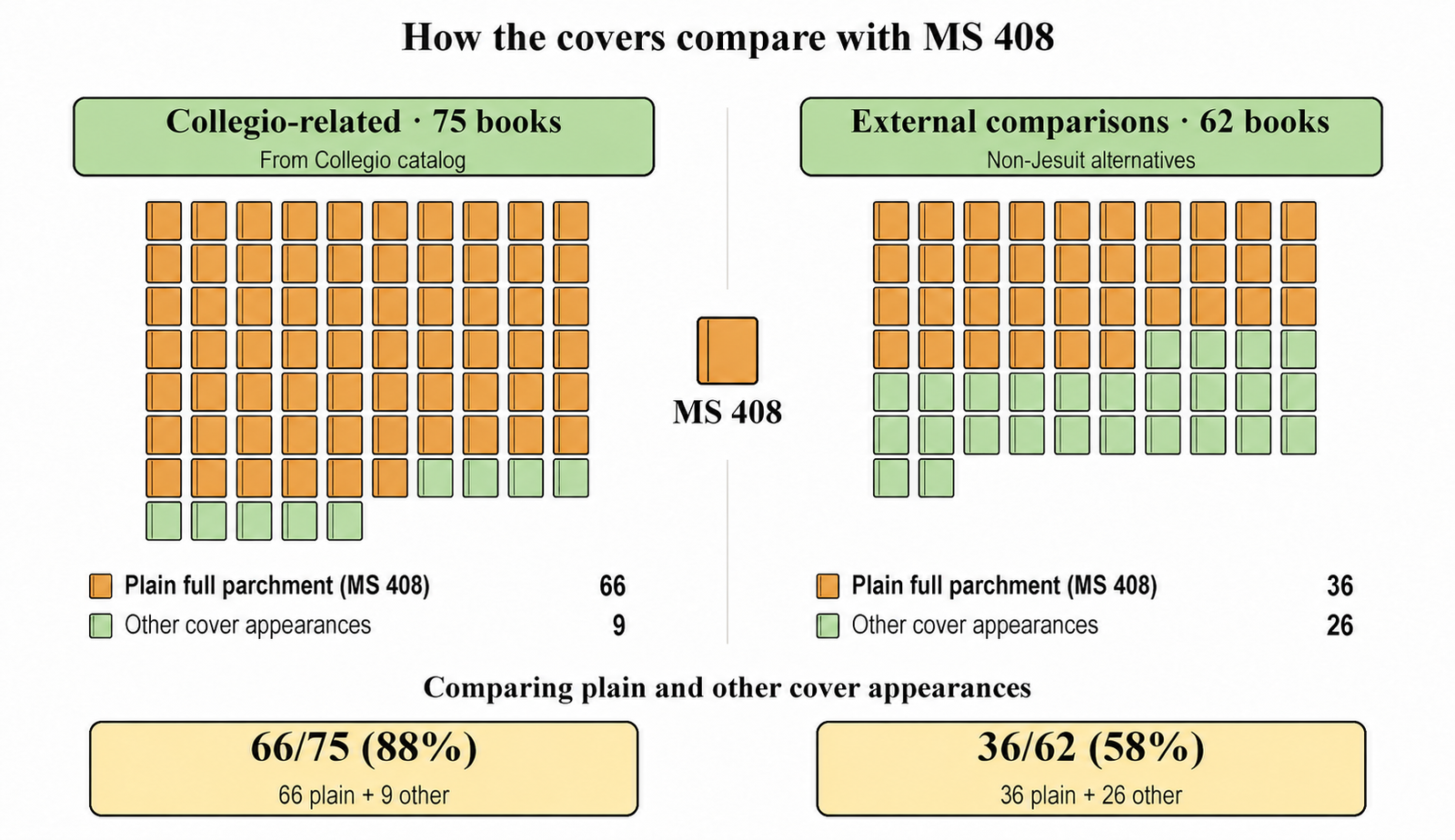
The investigation compares 75 catalog-linked Collegio-related books with historical parchment or partial-parchment covers and available photographs: 70 within the cited Vatican range, and 5 elsewhere. The external comparison contains 62 parchment-covered books with documented alternative historical contexts. These are selected cover comparisons, not a census of entire collections.
Plain full-parchment covers occur on 66 of 75 Collegio-related books (88 percent), against 36 of 62 external examples (58 percent). The broad resemblance is real and more frequent in the Collegio group, but also common elsewhere.
A plain parchment cover isn't a distinct calling card for a Jesuit holding.
“Plain parchment” still permits substantial variation in material, folds, fitting, and attachment. Figure 5 illustrates that variation; its generated examples are not facsimiles of individual manuscripts. Color and surface appearance also reflect photography, handling, and storage.
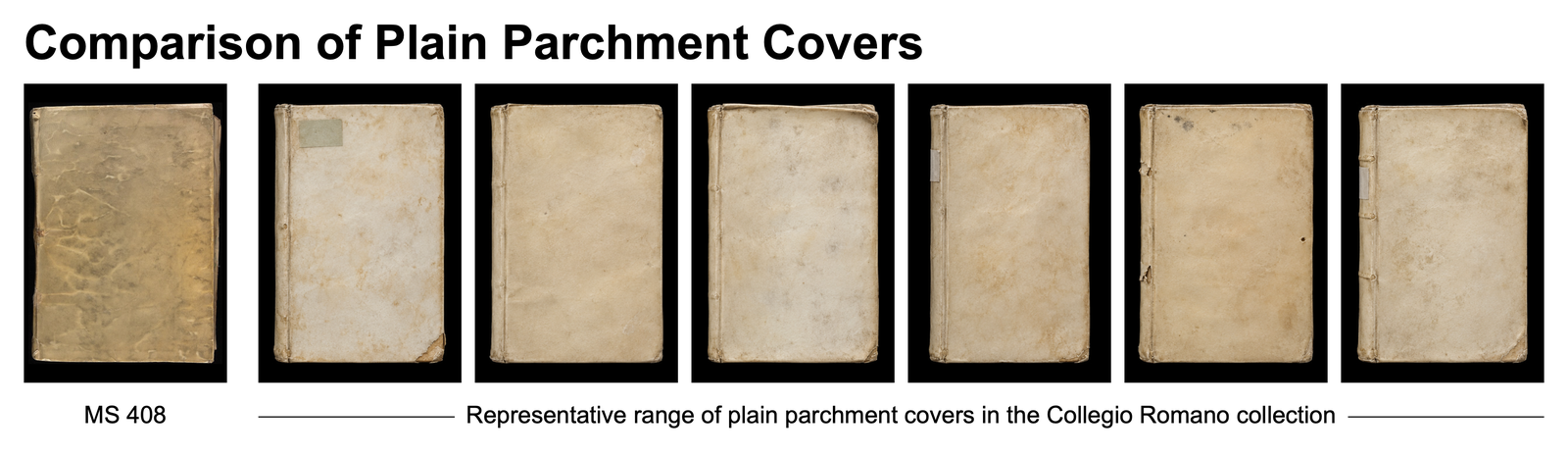
The question is whether the books merely share a general look or share construction features that might point to a common binding history.
Never overlook the corner cases
Where parchment turn-ins meet inside a cover, the visible junction may be diagonal or square-ended. The Voynich’s photographed corner shows the latter, rather than the diagonal arrangement predominant among classifiable Collegio examples.
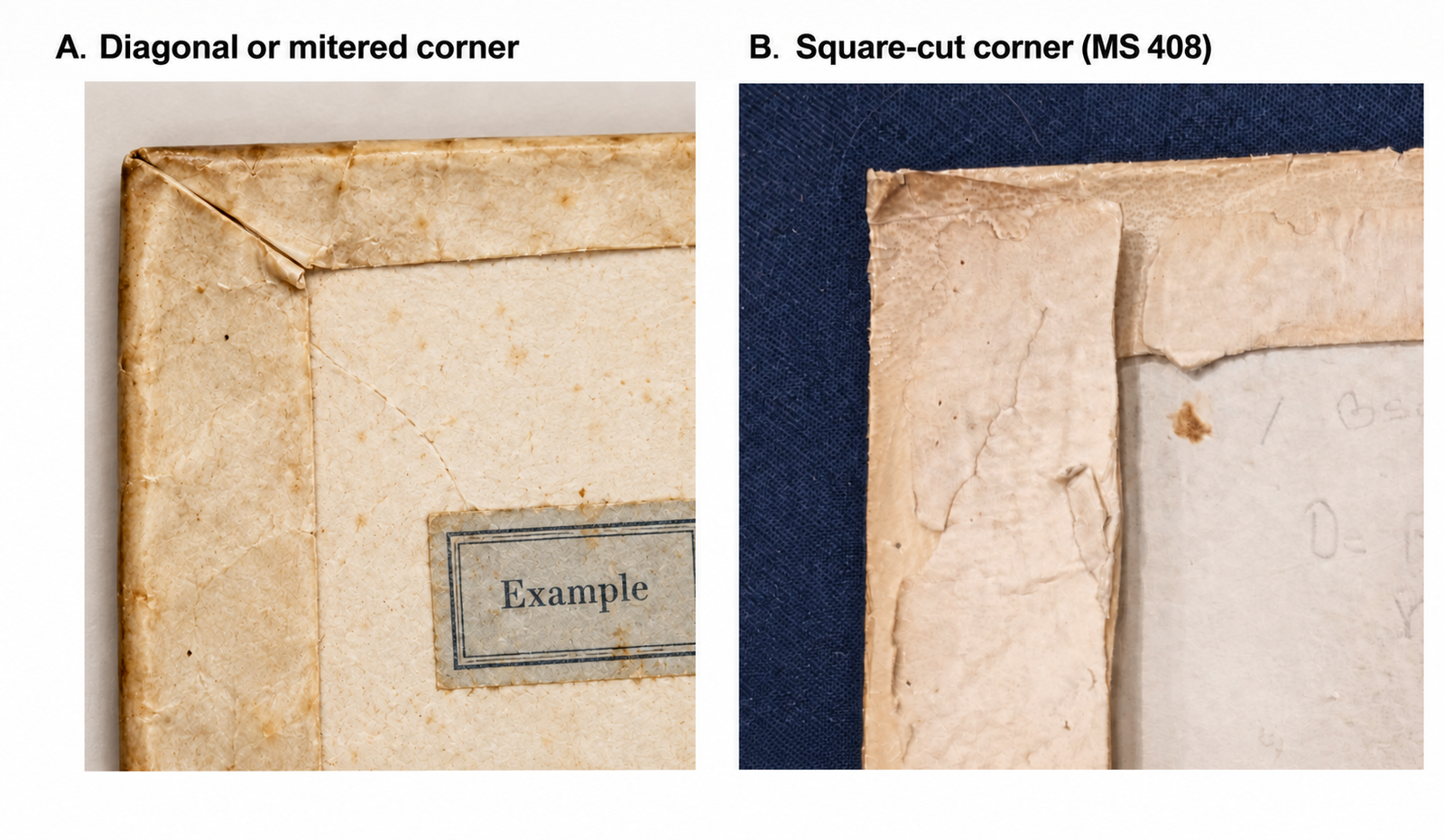
Using the same visible-junction rule for both groups gives:
- Collegio-related: 46 diagonal, 2 square-ended, 6 non-comparable, and 21 indeterminate or unavailable.
- External: 18 diagonal, 3 square-ended, 3 curved or tapered, 5 non-comparable, and 33 indeterminate.
Among diagonal-or-square cases, the Voynich-like arrangement occurs in 2 of 48 Collegio cases (4.2 percent) and 3 of 21 external cases (about 14 percent).
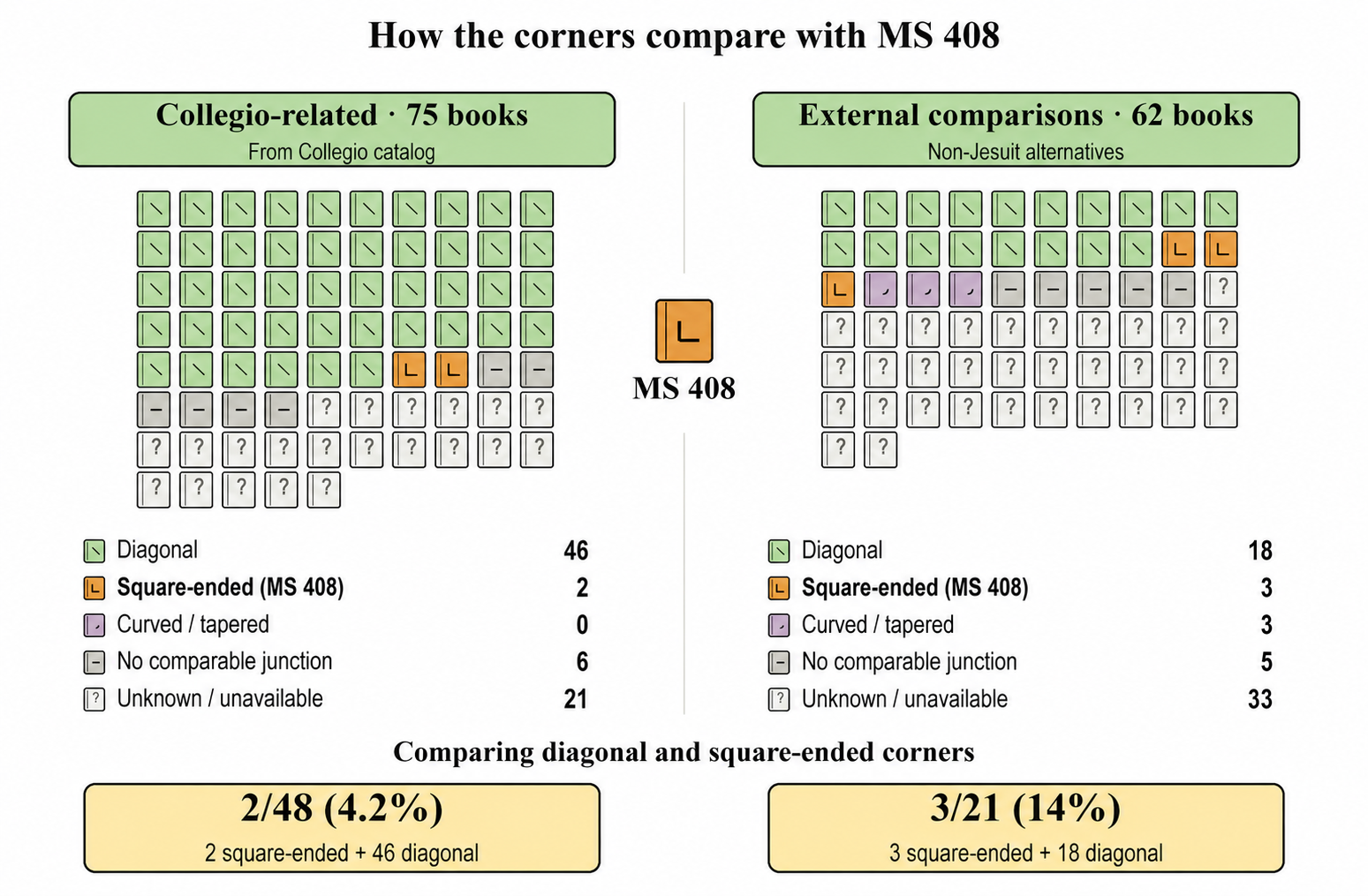
Small counts and many uncertain corners limit the inference. These results do not exclude a Collegio origin or establish population-wide differences. They show recurrence elsewhere and no demonstrated distinctive Collegio affinity for this feature. Visible junctions do not establish hidden cuts or identify binders.
The Collegio Romano Survey Study provides the fuller record of this investigation: methods, manuscript comparisons, and results. A binding attribution would require a broader conservation-level comparison of sewing, lacing, supports, linings, endbands, and adhesive against independently attributed examples.
Limp vellum was everywhere
There's another, bigger problem with the "looks like a Jesuit binding" argument. Plain parchment bindings, limp or semi-limp, weren't a Jesuit speciality. They were among the most common bindings in early modern Europe.
Specialist research documents their use across commercial, private, and institutional settings. Books could enter Jesuit libraries already bound; superficially similar covers could conceal different structures. The full article’s studies and additional example illustrate that wider tradition.
It's like noticing that a car is a white sedan and concluding that it must belong to a particular rental company because their fleet is mostly white sedans. It's not wrong that their fleet is white sedans. It's just that so is half the parking lot.
So who could have bound it?
Possibilities include an earlier owner; Baresch or Marci; Kircher or a later Jesuit custodian; a custodian after the 1773 suppression; or the restored Jesuit administration after 1824. None is established.
De Ricci’s 1937 Census tentatively assigned the wrapper to the sixteenth century, earlier than Yale’s eighteenth–nineteenth-century assessment. That alternative deserves examination, but a personal inspection by de Ricci has not been confirmed. The separate Marci Letter Reconsidered argues that the letter may have entered the present binding soon after being sent to Kircher. This, too, remains an interpretation rather than a settled date.
Sorting the claims
The evidence supports some claims more firmly than others. Table 4 brings them together, distinguishing what is documented from what remains plausible, uncertain or unsupported. As for who is actually responsible for the present cover and when? That remains an open question.
Table 4 (full article). What the evidence supports, claim by claim.
| Claim | Status |
|---|---|
| Some of the present attachment is twentieth-century repair | Established; based on documentary evidence |
| The present cover replaced an earlier binding, probably in wooden boards | Strongly supported; based on physical evidence |
| The present cover is later than the manuscript | Strongly supported; however, no narrower date has been established |
| The “Miscellanea, c.m.s. XV” refers to the Voynich Manuscript | Plausible: the description is consistent with the Voynich but does not distinguish it from other manuscripts. The basis for its fifteenth-century dating and the later marginal identification remainsunexplained |
| The manuscript was associated with the former Collegio Romano collection | Plausible; but the documentary chain is not fully independent |
| The cover could have been applied during Jesuit custody | Plausible |
| The present cover dates to the eighteenth or nineteenth century | Unsupported; Beinecke’s catalog dates it to this range, but there is no available basis for the assessment for the entry |
| The present cover belongs to a standard, uniform Jesuit binding type | Unsupported; the plain exterior is more frequent in the selected Collegio group, but the square-ended corner is not; the combined evidence does not establish a preferential resemblance to Collegio bindings. |
| The present cover shares a distinctive binding type found on the vast majority of the cited Vatican manuscripts and therefore attributable to the Jesuits | Unsupported; broad exterior similarity has some supported, but the existence of a distinctive Jesuit binding type remains unsubstantiated, and MS 408’s corner arrangement matches only a small observed Collegio minority |
| The present cover was applied during the documented eighteenth-century Collegio Romano binding campaign | Unsupported; the campaign is documented, but no evidence connects MS 408 to it, and its recorded half-parchment bindings differ from the Voynich’s full-parchment cover |
| The present cover was part of an 1824–1870 rebinding campaign | Unsupported; based on a misreading of the source |
| The present cover was made or commissioned by Jesuits | Unsupported |
| The present cover was made at the Collegio Romano | Unsupported |
| "We know" the Roman Jesuits added the present cover | We don't |
What it would take
None of this is a reason to give up on the question. It's a reason to answer it properly. A real attribution would need something like:
- a record tied to this book, such as a binder’s bill, repair register, or catalog note;
- a recovered shelfmark or title in a securely dated system;
- conservation evidence separating manufacture from later repairs;
- controlled construction comparisons against independently attributed Collegio and ordinary commercial bindings.
Radiocarbon dating could constrain the age of the cover parchment. It would date the material, not the act of binding, because parchment could be stored or reused.
The honest description is not "the Jesuits rebound it". It's this:
That's less exciting than "we know". But it's what the evidence actually supports. The important lesson is to beware of overly confident claims built on thin evidence; they tend to get repeated until the mere questioning of them becomes taboo.
Comments, questions, and suggestions are welcome. (You can post them in the form at the bottom of this page.) If something here needs correcting, I’ll be glad to revise it; if a point needs clarification, I’ll do my best to explain it.
Sources and further reading
Read the full article for the complete bibliography, deeper documentary discussion, and a table of links to the original comparison photographs.
Comments
2 responses to “The Case of the Voynich Manuscript: A Questionable Cover Story”
yep. the more absolute the claim, the more likely something important is being left out
It is some time since I demonstrated that while it is probable the ms was addressed to Kircher at the Collegio Romano (Mondragone), there is no evidence it remained there for any length of time and that Zandbergen's assumption it was there right up until the time Beckx left Rome, or subsequently in the Vatican collection is without justification - even from what little Voynich said about his 'find' before his death. The evidence only allows us to have it brought by Beckx from Fiesole to one or other of the places to which he went before his own death. I wrote this up a couple of years before an Italian scholar published a closely-similar conclusion from their own research. We differ only on which house in Rome. Naturally ( or more exactly, predictably) Zandbergen refused the normal obligation to acknowledge sources for new contributions in due order. :D